Disclosure Statement: This post contains affiliate links. When you click on an affiliate link and make a purchase, I receive a commission at no additional cost to you. All opinions are my own.
There is a holiday for literally everything now. From World Compliment Day to Super Mario Day to No Dirty Dishes Day (does a magical cleaning fairy come on that day?), there is no shortage of weird holidays. And why not? Every day that we are alive is worth celebrating – might as well have fun celebrating different things.
As I was surfing the Interwebs not too long ago, I came across a scad of wine holidays, including today’s Tannat Day. Realizing I’ve only had one Tannat in my life (to my knowledge) and that I have never blogged about it on here, I took it as a good excuse to pick out a bottle and learn a little more about this prized grape. Learning never ends for an oenophile!
So, here we are… Happy Tannat Day!
Just what is Tannat, anyway?
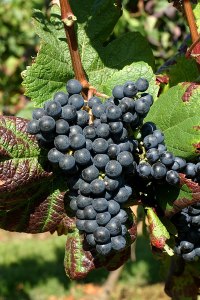
A cluster of the French grape variety Tannat. Photo courtesy Doris Schneider, Julius Kühn-Institut (JKI), Federal Research Centre for Cultivated Plants, Institute for Grapevine Breeding Geilweilerhof – 76833 Siebeldingen, GERMANY
Tannat is a red wine grape that originated in southwestern France, where it is known as Madiran (French wines go by place name not grape name). French immigrants hauled cuttings of their favorite grape down to Uruguay in the 1800s and began cultivating it. While it is grown in numerous countries the world over (including the USA), it has established itself as the top dog wine of Uruguay, in much the same way Malbec has become Argentina’s flagship grape.
Tannat grapes have extra thick skin and a higher amount of seeds inside than other wine grapes. Tannins come from the grape skins, seeds, and stems, and become an important part of wine during fermentation. When the wine is put in oak barrels for aging and development, this also imparts wood tannins. Thus, Tannat wines are by nature super tannic, but good winemakers will tame the tannins through practices like micro oxygenation and oak barrel aging, which allow small amounts of oxygen to soften the wine’s tannins. But not too much, because the high tannin levels are also the trait that will make Tannats age well/last a long time.
So, what’s all the health hype about? Tannins are polyphenols (one well-known one is resveratrol), or antioxidants, which are extremely important for our cell health. Tannins in wine are what cause bitter, astringent, sandpapery, or gritty sensations in your mouth. And Tannat has among the highest levels of polyphenols of any wine period. Other wines with mega-high levels of polyphenols include Sagrantino, Touriga Nacional, and Xinomavro (Wine Folly The Master Guide, pg. 19).
A fellow wine lover’s description of this Tannat on Twitter was compelling enough for me to purchase a bottle of the famed elixir. I decided it was time to get fully acquainted with this varietal, and what better day than on Tannat Day.
You who like big, bold, full-bodied reds, meet your new friend. A high quality friend whose price tag is very reasonable. And one who is very amiable. 🙂
Here are the details and my impressions of the wine:

Bodega Garzon Uruguay Reserva Tannat 2020
Bodega Garzón Uruguay Reserva Tannat 2020
- Currently $18/bottle on wine.com
- Deep purple
- Medium/full body
- Dry!
- 14% ABV
- Low-medium acidity
- Very smooth texture
- This wine is bitter from the tannins, but the resulting texture is not grippy or sandy at all, very well-integrated and full
- Aromas upon opening: rustic, earthy, animal, herbal, black fruits more subtle
- Aromas after decanting 1 hour+: black fruits, smoke, spice, minerals, graphite
- Flavors: black fruits (berry, cherry, plum, olive), meaty
- Not a long finish
- This wine is fine to sip solo, but because it is quite dry and bitter, I would recommend serving this wine with food to really let it shine (barbecue obviously and other rich, fatty dishes)
So there you have it. You can’t go wrong with this Tannat; it has good ratings from critics across the board and is lauded for being a top example of Uruguayan Tannat in this price range. Start here and then proceed onward to other Tannats.
Raise a glass of Tannat today. Cheers to your good health! ❤
Anyone else imbibing Tannat today? Where from? Thumbs up/down? Comment!

 The Rambling Vine