Sweets for My Sweet: A Dessert Food + Wine Pairing

Hello, sweet readers! I hope you enjoyed your Valentine’s Day, and hopefully the fun is continuing into this week and beyond. Love should not be limited to just one day, am I right? 😉

I apologize for not having this post up in time for Valentine’s Day; full-time life has a way of being full-time. No complaints. Even though February 14th has come and gone, this is something you can enjoy anytime just for the fun of it; no reason needed. ❤

Andiamo! Today, we’re zipping over to Italy in our wine glasses; to be specific, the Piedmont region of Northwest Italy, which is famous the world over for a sweet, sparkling dessert wine: Moscato d’Asti.

I recently shared with you how sparkling wine is made, via the traditional method and the tank method. There is a third way known as the Asti method, which we’ll talk about now.

While your traditional and tank method sparkling wines (e.g. Champagne and Prosecco) begin with dry wine, sugar, and yeast, an Asti method sparkling wine starts with grape juice and yeast. The yeast begins to ferment the grape juice in a sealed, pressurized tank. The initial carbon dioxide created from fermentation is allowed to escape, but then along the way the tank is resealed and additional carbon dioxide generated is trapped inside, creating bubbly wine. Before the yeasts completely eat all the sugars and create a dry wine, they are stopped via filtration and removed. This means there is still sugar (sweetness) left, and thus you have a sweet, low alcohol, sparkling wine.

So what is Moscato d’Asti and why choose it for Valentine’s Day? Or for any time?

  • Muscat (Moscato is the Italian name) is one of the earliest domesticated wine grapes: a supremely aromatic white grape variety hailing originally from Greece. When you hear the phrase, “nectar of the gods”, I imagine the Greeks could have been talking about Muscat wine. And it’s funny because ambrosia, the canned fruit cocktail/whipped cream/marshmallow salad, is a potent aroma of the wine.
  • It tastes REALLY good! It’s a delicious dessert wine that will please someone who maybe is not a “huge wine drinker” but it will also please a connoisseur. It’s a famous wine of the world you just need to know about.
  • It tends to be pretty affordable, so you can spend your extra money on other things for your loved one(s).

There are a number of options on the market, but I went with this entry-level one because it is delicious, widely available, and also I love the blue glass bottle:
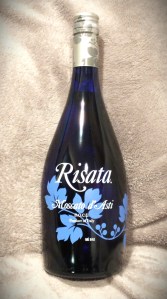
Risata Moscato d'Asti

Risata Moscato d’Asti

  • $10.97 at Total Wine & More
  • 5.5% ABV
  • Pale lemon color
  • Sweet!
  • Light body
  • Low alcohol
  • Delicate, fizzy bubbles
  • Aromas of seashell, honeysuckle, pear, lime, orange, stone fruit, honey
  • Flavors of grape, peach, tangerine

This wine is obviously plenty delightful on its own; it is, after all, a dessert wine.

But believe it or not, Moscato pairs beautifully with desserts. Wedding cake never met a better match.

Don’t believe everything you hear about “champagne and chocolate” or “champagne and cake”. If you’ve ever actually put those things together in your mouth at about the same time, you know those combinations are heinous, and I do not use that word lightly. All kinds of foul and nasty flavors that never should be are suddenly at war on your palate.

Please. Spare yourself and your loved ones the atrocity and serve Moscato with your wedding cake.

For this pairing, I baked some sugar cookies with vanilla buttercream frosting. I even tried a cookie (or two) with a glass of Moscato, just to make sure it wasn’t going to be horrendous.

Spoiler alert, it was anything but! You are going to love this! ❤

All this tasting and experimenting is hard work, but that’s my job as a wine blogger: to serve you and protect you from vile food and wine pairings. And I take my duties seriously! 🙂

These cookies are buttery, scrumptious morsels that say “I love you” in every bite. They are also customizable, in that you can play up the flavors in the buttercream frosting to complement the flavors in your Moscato. Think vanilla or almond extract, citrus zest, maybe even a touch of peach or pear juice/syrup? Just pick one flavor at a time, though. 🙂
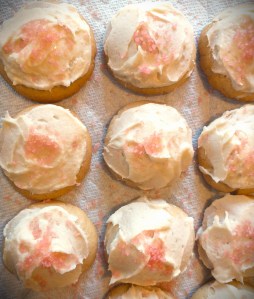
Sugar Cookies with Vanilla Buttercream Frosting

“Take me to your Moscato….”

Sugar Cookies with Vanilla Buttercream Frosting
(Heavily modified from the sugar cookie recipe in The Cookie Book by Rebecca Firth)
Makes approximately 48 cookies
*If you do not have a large-capacity stand mixer (6-8 quarts), this recipe will be taxing on your mixer (it’s a huge quantity of cookies). Halve the recipe, if you want. I would advise using an electric hand mixer or your own brawny muscles and a very durable spoon. 🙂

The Cookies

Ingredients

  • 24 T unsalted butter, room temperature
  • 1 1/4 c. granulated sugar
  • 1/4 c. light brown sugar, packed
  • 2 large eggs, room temperature
  • 2 tsp. real vanilla extract
  • 3 1/2 c. all-purpose flour
  • 1 c. bread flour
  • 1 tsp. sea salt
  • 1/2 tsp. baking powder
  • 1/2 tsp. baking soda

Instructions

  • In a large bowl, whisk together the flour, bread flour, sea salt, baking powder, and baking soda. Set aside.
  • In an electric stand mixer fitted with the paddle attachment, add the butter, sugar, and brown sugar and mix on medium for about 4 minutes, until light and fluffy.
  • Scrape down the sides and bottom of the bowl. Add the eggs and vanilla and blend completely, scraping down the sides of the bowl as needed.
  • Add the dry ingredients to the butter mixture and run the machine for 1 minute more, or until blended.
  • Preheat the oven to 375° and cover several baking sheets with parchment paper.
  • Grab a slightly larger than a tablespoon amount of dough, roll it in to a ball, then flatten slightly between your palms and make a slight downward indentation in the middle (for easier frosting later on). Place cookies on baking sheets spaced about 1 inch apart from each other.
  • Bake one sheet at a time for about 12-14 minutes, until lightly browned around the edges. This will depend on your oven temperature, how many cookies are on your tray, and the size and thickness of your cookies. Eyeball it.
  • Let the cookies cool for 5 minutes on the baking sheet, then transfer to a wire rack to finish cooling.

Buttercream Frosting

Ingredients

  • 8 T unsalted butter, room temperature
  • 2 1/2 c. powdered sugar
  • 1-2 T milk
  • 1-2 tsp. extract, fresh fruit zest or fresh fruit juice to flavor, optional (but recommended!)
  • Gel food coloring, optional
  • Sprinkles, optional

Instructions

  • To make the buttercream, in an electric stand mixer fitted with the paddle, add the butter, powdered sugar, and milk. Mix on medium until smooth.
  • Add in any extracts for flavor or food coloring, if using.
  • Add more powdered sugar in 1 T increments if the buttercream is too thin, or, conversely, add more milk in 1 tsp. increments if the buttercream is too thick. Proceed with sprinkles, if using.
  • Frost your cooled cookies. Since this frosting contains milk, everything will need to be stored in a covered container in the fridge for up to one week.

Is your sweet tooth stimulated? For additional Valentine’s Day food and wine inspiration, check out some past posts:

Barbera
Snickers Cheesecake
Grape Galette and Sparkling Wine

Dark Chocolate and Ruby Port
White Chocolate and Orange Muscat
Charcuterie and Wine Pairings
Milk Chocolate and Brachetto
Chocolate and Brachetto
Wine + Chocolate: Finding Dark Chocolate’s Soul Mate

Disclosure Statement: This post contains affiliate links. When you click on an affiliate link and make a purchase, I receive a commission at no additional cost to you. All opinions are my own.

Wine and chocolate… two of God’s most revered gifts and humanity’s most celebrated gustatory creations, coming in a range of colors and flavors. You already know how divine Brachetto and milk chocolate can be together. I posted on it last year and apparently I had posted on it years before. (Oops. Just take that as a sign of how good it is.) 🙂

But are wine and chocolate better together, or should each just be enjoyed on its own? If so, which ones work together and which ones flat out don’t? Since Valentine’s Day is imminent, I’d like to explore this question with you, with the goal of sending you home with an amazing wine and chocolate pairing that will score some serious brownie points with your loved one(s). No pun intended with the brownies.

Today, we’re going to step out of the light and into the dark and sensual realm of chocolat noir. But what to pair with the darkest of the dark, the richest of the rich? Be prepared – it’s an indulgent pairing that may or may not be what you’re thinking.

Compared to milk chocolate, dark chocolate is bitter, with fruity notes, and very tannic, thanks to those blessed polyphenols that are so good for us and cause the grippy sandpapery feeling in our mouths. And what do a lot of red wines tend to be? Dry, bitter, and tannic. You would think all these shared traits would make for a great pairing, but it frequently has the opposite effect in the mouth – bitter and bitter do not make good bedfellows (duh, says every couple alive). Some other red wines probably go well with dark chocolate, but pairing can get tricky and takes some trial and error. You have to take into account more factors in the wine (sweetness, alcohol, acid, tannin, fruit, etc.), and this requires more experimentation than I have time for today (or tonight as I write this).

But one type of red wine is always a sure bet and a foolproof partner to dark chocolate… ruby port.

wine and chocolate pairing

You have to try it to believe it.

Ruby port? you ask, confused. Not Cabernet Sauvignon? Not Merlot?

Um, a resounding yes, and here is why.

Ruby port and dark chocolate are a perfect match because they create balance together. The richness, intensity, and body of both are similar, but the port’s sweetness contrasts beautifully with dark chocolate’s bitterness. Dark chocolate will simply amplify bitterness and tannins in a dry red wine like a Cab or Merlot and make for a disappointing pairing. We can’t have that now, can we?

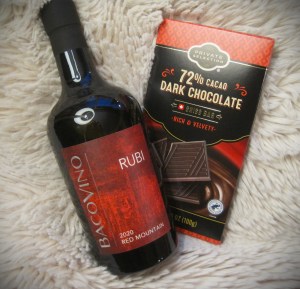
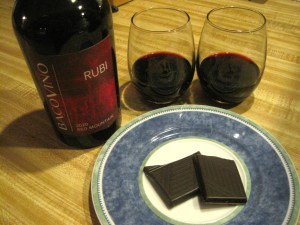
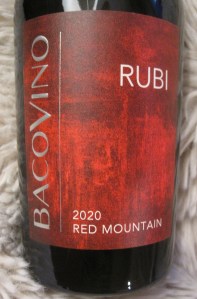
I am lucky enough to have some Bacovino Rubi 2020 Red Mountain Dessert Wine lying around, and opened some up to pair with dark chocolate. Sumptuous, silky, and made from Washington Syrah grapes versus the traditional Portuguese grapes (various Tourigas and Tintas), it’s a divine treat that showcases well the depth and beauty of Washington grapes in this wine style.

Here is all you need to know about this lovely wine:

Bacovino Rubi 2020 Red Mountain

  • 100% Red Mountain Syrah made into a port-style dessert wine
  • $45/bottle
  • 19.5% ABV
  • Beautiful label that commends itself as an attractive Valentine’s Day gift
  • Sweet and smooth but the acid and alcohol pull it back from “syrup” territory
  • Delicious right now, but imagine laying it down for a number of years – whoa baby! It will just continue to get richer and more complex with age.
  • Deep ruby color
  • The winemaker notes: “Appealing red fruit and white pepper followed by a lengthy, candied finish.”

For the dark chocolate, I used Private Selection 72% Cacao Dark Chocolate Swiss Bar from my local grocery store. It’s absolutely delicious chocolate and is typically less than $3/bar (so you can splurge on this amazing dessert wine). When paired with the port, it’s like a chocolate covered cherry exploding in your mouth. Dear. God.

Bacovino Rubi and Dark Chocolate

Look no further for your Valentine’s Day gifts.

While there are numerous wine and chocolate pairing recommendations for Valentine’s Day, many might not be steering you in the right direction. Ruby port and dark chocolate is a time-tested, decadent, indulgent pairing that is a guaranteed hit. You could use any dark chocolate bars, truffles, or even a flourless chocolate torte. Just make sure it’s dark chocolate, not milk.

Random tip from a winemaker I spoke to not too long ago – she recommended enjoying port/dessert wine as an aperitif (a before dinner drink). I tend to think of port keeping post as the ultimate dessert wine/after dinner drink (which it rightfully does), but what a novel way to think about it: a little treat for when you want to sip some wine while you make dinner. Put it in a little crystal glass and turn cooking dinner into less of a chore. 🙂

Are you a dark chocolate & ruby port fan? Comment below with your favorite brands! And let me know if you try the Rubi. 🙂

Happy Valentine’s Day/Wine & Chocolate Day, readers! ❤

NatGeo Award Classics Campaign

Celebrate Oregon Wine Month with Baco Noir Dessert Wine

Disclosure Statement: This post contains affiliate links. When you click on an affiliate link and make a purchase, I receive a commission at no additional cost to you. All opinions are my own.

How is this month slipping away from us SO quickly? And by the way, spring seemed like a flash in the pan this year, are we in spring or summer? My brain and body are having a hard time distinguishing what mode we are in. So before any more time sneaks away, it’s time to devote a post to good Oregonian juice in honor of Oregon Wine Month!

I ADORE Oregon wine, do you? Perhaps a large reason is that I have spent a lot of time down there exploring and trying lots of wines, so the gorgeous settings and scenery have helped seal my devotion. I would probably say similar things about other places if I visited them more often.

I love all varieties and styles of wine and Oregon has an incredible range to offer. There’s so much more than simply Willamette Valley Pinot Noir (although that’s one of my favorites) – I thought we’d journey farther south in the state and also venture into dessert wine territory, which we haven’t been to in a while. Baco Noir is a rare grape that here has been made into a dessert wine. Port fans, pay heed!

Melrose Vineyards is an estate winery located in Roseburg, Oregon. Roseburg is located in the southern part of the state, in the Umpqua Valley AVA. The climate is Mediterranean, with very warm and dry summers and cool and wet winters. Summer also has greater diurnal temperature variation than in winter.

So what is Baco Noir? According to Wikipedia, Baco Noir is “a hybrid red wine grape variety produced by Francois Baco from a cross of Vitis Vinifera var. Folle Blanche, a French wine grape, and an unknown variety of Vitis riparia indigenous to North America.” Baco Noir is cultivated throughout Oregon, including River’s Edge Winery in Elkton, whose Pinot Noir I introduced you to a while back.

We found this wine when we wandered into Face Rock Creamery in Bandon, OR last summer (try their Vampire Slayer Cheese Curds!). The Creamery is a mecca for gargantuan ice cream cones, especially in the warm summer months. Seeing we had kids in tow, the kind gal inside almost stopped us at the door and let us know that sadly they were out of ice cream that day. We told her that was OK; we were there for the cheese – and turns out the wine, too! Their retail store has a great selection of various Oregon wines and I couldn’t help picking up a couple unusual bottles while we were there, along with some cheeses. This was one of the bottles.

Solstice Solera VII Melrose Vineyards Baco Noir Dessert Wine Umpqua Valley

Solstice Solera VII Melrose Vineyards Baco Noir Dessert Wine Umpqua Valley

Solstice Solera VII Melrose Vineyards
Baco Noir Dessert Wine Umpqua Valley
Melrose Vineyards, Roseburg, OR
$19/bottle
ABV 19.8%
“It has layers of woven complexity of currant, fig, praline caramel, with deep tones of dark chocolate. The age of this VII Solera became accentuated with the most recent vintage to keep the fruit in focus and amazing. The winemaker’s favorite longstanding wine.”

My husband adores this wine. I also loved it, and I wish I had taken more technical, detailed notes, but alas, that did not happen. I recall it being heavy but elegant, rich, warming, lovely sweetness, and alluringly complex. Like a Port in some ways but also something completely different. Basically… YUM!

I think this sumptuous dessert wine could be very congenial with pecan pie, marionberry cheesecake, or a brownie, or else some tasty cheeses and fresh fruit. I have not personally tried any of those pairings (I may be BSing right now?) 😉 but I have a hunch those would all work.

Cheers to Oregon, its wine, and the “lush-y” month of May! What delightful wines from Oregon have you found? Share!

Explore Wines from Across the Country.