In which I taste through some of the all-time heavy-hitters of Washington State Cabernet Sauvignon, and why you should attend a wine seminar….
Happy St. Patrick’s Day, readers! Up here in the Pacific Northwest, we are on the cusp of spring and the weather is acting accordingly: dreary, drizzly, rainy, windy, but with pink and white cherry blossoms and yellow daffodils fighting against the gloomy grey, like eager students waving their hands in the air to be called on. I am feeling hopeful for the new season that shall soon be upon us.
I don’t know why “they” picked both March and August, but March is officially Washington Wine Month: a chance to focus on and celebrate the great and special wine of the Evergreen State. Maybe they picked March because March is still basically winter and everyone is getting really sick and tired of the winter drudgery at this point (and needs some good wine to pull them to the spring finish line). Anyway, it’s when the Washington State Wine Commission puts on a week’s worth of special events in Seattle called Taste Washington, which encompasses everything from winemaker dinners to educational seminars.
In 2023 (I missed 2024), I attended Taste Washington’s Seminar, “Washington Vs. The World: The Ultimate Blind Tasting.” This was a fantastic event and I’m still baffled as to how it took me so long to figure out this happens annually in my city. We wine lovers gotta scratch our itch to learn about wine, and I can’t think of a better opportunity that delivers on that without costing you substantial time and money, like earning a certificate or diploma in wine. I am glad I found an activity worth doing every year for the enjoyment, the opportunity to try rare/expensive/unusual wines, and the chance to further my wine education.
I couldn’t resist attending this year, especially with one of the seminars titled, “King Cabernet: A Historic Tasting of Washington’s Finest.” I mean, really, would you pass up a chance to taste 10 of Washington’s finest/most premium/highest-scored Cabernets for way less than the cost of many of the bottles themselves? I think not! So, thanks to some birthday money from my in-laws, I went ahead and signed up. 🙂
Since the dress code called for business casual, I rounded up an outfit from the “distant work past” section of my wardrobe, put on makeup, and moved my personal items from a fanny pack to a leather handbag. My outfit was probably more business and less casual, when I think about it, but better to err on the side of formal than informal. After all, drinking wine is always a special occasion and sometimes we should approach it with some reverence. 🙂 I no longer need this kind of fancy wardrobe except for maybe once a year – thank God, because my legs hurt from traipsing around in my heeled leather boots – but from time to time it’s fun to dress up and feel a little more put together than my usual, painfully casual mom attire. 😉
My husband drove me to the seminar, which took place at the Embassy Suites Hotel right next to Lumen Field Event Center, where the Grand Tasting events (large scale event featuring tastings from over 200 wineries and over 75 restaurants) were happening immediately after the seminars. While I did my wine thing, he took the kids to explore the fabled Seattle waterfront in an effort to give the city a chance to prove we should not talk smack be entirely negative about it. I will not mention the sights and aromas of our last trip to the waterfront several years ago for an aquarium visit. But I digress….
Here is the official description of the seminar:
“Amazingly, Cabernet Sauvignon only became Washington’s most-produced grape variety just over a decade ago. Today, not only does it dominate production and plantings, but also defines many of our most critically acclaimed wines: wines that stand out for their balance, elegance, depth, and sense of place. Here, in the best flight of Cabernet Sauvignon ever poured at Taste Washington, we’ll present a show-stopping array of some of the state’s finest and most celebrated masterpieces. Discover what makes Washington Cabernet so distinctive, explore the regions where it shines brightest, and learn about the exciting future of this esteemed variety. Join us to experience why Cabernet Sauvignon has earned its title as Washington’s unrivaled king of grapes.”
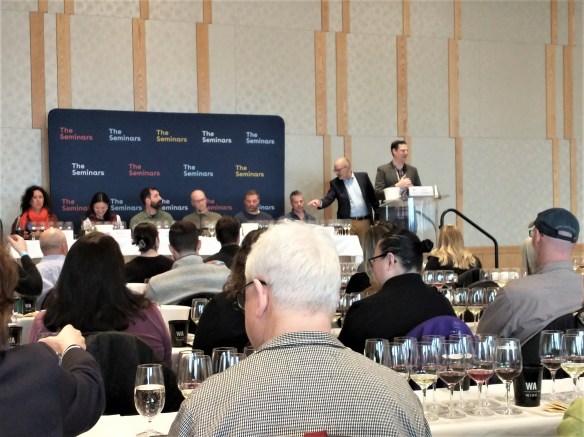
The seminar was moderated by Bob Betz, MW (Master of Wine), a well-known Washington winemaker and figure in the state wine scene. Bob explained that he did select the lineup of wines based on critics’ scores – he wasn’t just pulling his personal favorites (his winery’s wines just happen to score in the top). 🙂 We were instructed to sip on the wines in whatever order we desired as the panel members talked. The panel consisted of the following individuals – all winemakers whose wines we were drinking except for one wine critic whose specialty was Cabernet Sauvignon:
- Virginie Boone, JebDunnuck.com
- Will Camarda, Andrew Will
- Stephanie Cohen, Col Solare
- Ray McKee, Trothe
- Gilles Nicault, Long Shadows
- Louis Skinner, Betz Family

Bob and the panel laughing about something. 🙂
There was a lot of talk about Cabernet Sauvignon: about why it’s a noble variety and one of the top quality wine grapes in the world, why it shines in Washington state, but the purpose of this post isn’t to lose you in the mire of technical details; in fact, I really didn’t even take notes, as I wanted to drink in the information but mainly just relax and drink up the wine. 🙂 Suffice it to say, it does really well with the climate and soils of Eastern Washington and makes a fine, long-lasting wine, thanks in part to its dark skins (anthocyanins) and skin to seed ratio. Essentially, it has the tannins, acid, and alcohol to make rich, bold, long-lasting wine.
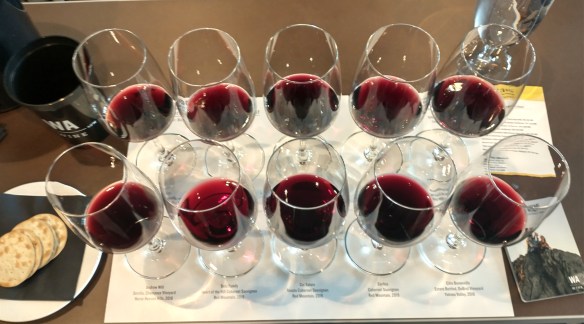
Here is the illustrious lineup of Cabernet Sauvignons that I got to imbibe:
- Andrew Will, Sorella, Champoux Vineyard, Horse Heaven Hills, 2018 ($97)
- Betz Family, Heart of the Hill Cabernet Sauvignon, Red Mountain, 2019 ($135)
- Col Solare, Tenuta Cabernet Sauvignon, Red Mountain, 2019 ($200)
- Corliss, Cabernet Sauvignon, Red Mountain, 2019 ($125)
- Côte Bonneville, Estate Bottled, DuBrul Vineyard, Yakima Valley, 2018 ($125)
- L’Ecole No. 41, Estate Grown, Ferguson Vineyard, Walla Walla Valley, 2017 ($105)
- Long Shadows, Feather Cabernet Sauvignon, Columbia Valley, 2021 ($85)
- Quilceda Creek, Cabernet Sauvignon, Columbia Valley, 2021 ($250)
- Trothe, Cabernet Sauvignon, Horse Heaven Hills, 2021 ($240)
- Woodward Canyon, Old Vines Cabernet Sauvignon, Washington, 2021 ($110)
Before attending this seminar, I had already tried several of the wines, a couple of which I had won at charity auctions back in the day, including a Quilceda Creek red blend and Col Solare red blend. I’ve had L’Ecole No. 41 wines in Walla Walla at the winery, Côte Bonneville’s ultra-premium 2013 Cabernet Sauvignon at a special winemaker dinner in Woodinville, and Betz Family Syrah that I purchased from Total Wine for a blind tasting. For five of these it had been a minute since I’d tried them, so it was good to have a refresher course. And for the other five, it was a privilege to get to try producers that were new to me.
I appreciated trying the wines side by side with others from similar and different regions, vineyards, vintages, etc. to compare and contrast. For example, I would sniff all three of the 2019 Red Mountains from Col Solare, Corliss, and Betz side by side, comparing, or the Horse Heaven Hills wines (Trothe and Andrew Will). Some of the Cabs were very strong in fruit and floral aromatics, while others were more subdued, with less pronounced fruit and more herbal and mineral aromas. All were excellent; at this point it was just a matter of personal preference, sort of like comparing apples to apples. And when you factor in drinking one of these wines with a fine meal, who knows how that might change your perceptions.
 In Washington state, winemakers are legally allowed to add small amounts of other wines (up to 25%) to get a single-varietal wine the way they want it to be (think other Bordeaux varietals, which are Merlot, Cabernet Franc, Petit Verdot, Malbec, Carménère). So it can still be called Cabernet Sauvignon on the label as long as it is at least 75% Cabernet Sauvignon. I’ve had 100% Cabernet Sauvignon wines before in lower price ranges. Do all the truly fine, upper echelon Cabs depend on dabs and dollops of Merlot and Cab Franc to put them at the top? Perhaps, but I don’t know.
My favorite of the day, if I had to pick, was Quilceda Creek. Sure, it was the most expensive wine, but I’m pretty good about not letting price bias me. It tasted magnificent in my mouth, no faults whatsoever. Pure bliss. I polished off the glass because it would have violated my conscience to leave it. It was a crime to leave the other wines on the table but that my friends is the nature of a wine tasting, and you just have to make peace with it. Otherwise your liver will revolt! 🙂
I noticed that the two gentlemen I sat between both polished off their Quilceda Creek with no problems as well, and they both admitted to loving it.
My other stand-out favorites were Woodward Canyon, Betz, and Col Solare.
But all the wines were memorable, wonderful, and superbly delicious. What a treat. ❤
As far as the question of price – is it really worth spending anywhere from $85 – $250 on a bottle of fine wine – my answer would be a) yes, if you can get someone else to buy it for you 😉 and b) if you’re buying it, and funds are finite, then just once in a great while. You could also go in with friends and decide to share one of these bottles with a fine meal or just some epic charcuterie.
Drinking fine wine is like enjoying a Wagyu steak: it’s still steak, but it’s so unique and almost different from steak it’s in its own category, and you don’t eat it every day. In fact, when I’ve gone out for fancy steak dinners, I sometimes prefer the lower-priced, corn-fed cuts because I like them. Fine red wine vis-à-vis less expensive red wine is the same. But here’s the really great news: you don’t have to spend an arm and a leg to get FANTASTIC Cabernet Sauvignon (and so many other wines) in Washington State. You really don’t.
While there are numerous Taste Washington events – including The Grand Tasting, the two-day wine and food extravaganza at Lumen Field Event Center with hundreds of restaurants and wineries – if you have to choose just one event, I vote for attending one of the seminars. Why? For much less money (I spent $108, even after all the lovely added charges and fees), you get:
- To sit and relax for an hour and a half, not having to spend hours on your feet jostling around in a crowd
- To hear from the winemakers firsthand and learn a lot about your selected topic
- To ask questions directly of the panel, should you so desire
- 10-12 pours of outstanding wines (in this case, ultra-premium Cabernet Sauvignon)
- Last I checked, general admission on Sunday (the cheaper of the two days, I believe) was hovering at around a $150 price tag. Sure, you get to try TONS of wineries and restaurants, but if you’re interested in a calmer, more focused sit-down experience, a seminar is the way to go. They offered three seminars this year, and since all happen concurrently, you have to pick just one.
I’ve been to wine festivals and those are definitely fun and have their place. I love wandering up to the tables and having excited people pour me sips of delicious wine, and rubbing elbows with fellow wine enthusiasts. But if you have limited time and resources, and have to be selective of where you spend your dollars, the seminars have my wholehearted recommendation.
What about you? Have you attended any Taste Washington events, in particular the seminars? Do you have any similar events in your town? Comment!
 The Rambling Vine