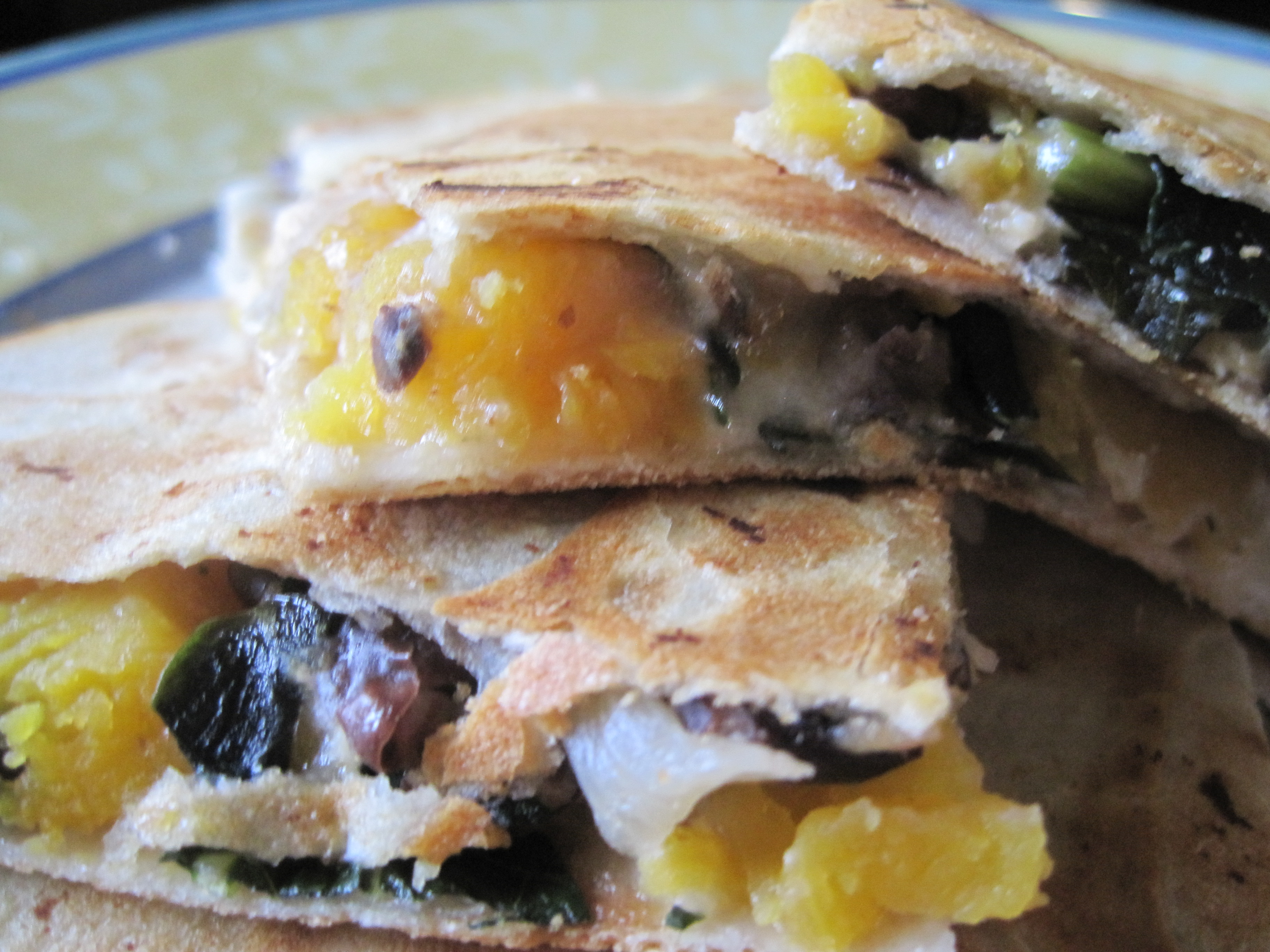
Butternut Squash Quesadillas

Ooey, gooey, melty, yummy, they’re calling your name! Photo by Brenna Arnesen.

It’s time, ladies and germs, for another respite from vino… off on a culinary excursion! Whet your appetites, it’s gonna be really good! 🙂

I love to cook, and I love the final, tasty fruits of my efforts even more. Apart from learning basics like spaghetti and scrambled eggs from my mom, I learned how to cook real meals using recipes. Rachael Ray and her pink cookbook get huge props for helping me beef up my skills to master chef status, especially when I lived on my own before getting married (As an Amazon Associate, I earn from qualifying purchases). I still tend to prefer using recipes when making meals, but as I gain more confidence, and the realization that not all recipes make perfect sense, I bravely make my own modifications and start trusting my own burgeoning culinary instincts… which is super important for every cook.

I’m maturing as a cook because lately, more than in previous years, I am now making up my own recipes. This is a huge step for a girl who is a cookbook maven (they are piled by my couch all the time for leisurely perusing and inspiration) and who has stuck to recipes much like a religious dedication to algebraic equations. I didn’t veer far from cookbooks, partly because I wanted to train myself by learning to follow a recipe verbatim and educating myself on process and terminology. But now I’m taking creative risks in the kitchen, and this is helping not only my cooking, but my whole outlook on life. Every time I cook, even though I’m using the same ingredients, it’s a new experience and new result every time. That’s the art of cooking.

One of the best ways to let your creative juices flow and have fun in the kitchen is to invent your own recipe. Not out of thin air, mind you, out of the inspiration you’ve gleaned from any fantastic eateries you have frequented. It only makes sense to borrow from the best and riff on them in your home kitchen. Most restaurants have their menus posted on their websites in PDF format, so you can refer back to the ingredients, or you can jot them down/take a picture with your phone when you’re dining there.

One such recipe I vowed to recreate at home and did — successfully, and even upped the nutrient quotient! — is butternut squash quesadillas from The Matador. Just uttering the phrase “butternut squash” puts me in a very happy place, so much so that I will order whatever item that is on the menu that has been blessedly paired with the saintly squash. It’s one of my favorite foods, obviously.

And this has become a new favorite recipe — made in a cinch, loaded with fiber and nutrients, and heartily filling. I just added the black beans and kale. You can find precut butternut squash at Trader Joe’s and if you would rather save time than money, this is well worth it. Of course, it’s not hard to prep an actual squash, but again, this requires planning ahead.

Purchase the quantities you need… this recipe paints in broad brushstrokes.

Butternut Squash Quesadillas
Tortillas
Sweet Onions
Kale
Can of black beans (try to make your own if you can, or scope out low sodium beans)
Cooked butternut squash chunks, perhaps a 12 oz. bag from Trader Joe’s
Goat cheese
Shredded pepperjack cheese

Slice or dice the onions (your call) and caramelize in olive oil (high heat first, then lower heat to saute). Add pieces of kale and saute. Add the cooked squash chunks and the rinsed black beans and warm through with the other ingredients. Move your filling to a separate dish. Take two flour tortillas; on one spread some of the filling and then crumble over some goat cheese and pepperjack cheese to your taste. Top with the second tortilla to make a frickin’ rad quesadilla, plop in a medium warm skillet to melt the cheese and heat through the middle, then flip to finish off the cooking.

¡Buen provecho, mis amigos!

Chai This Out: Oatmeal Cookie Makeover

Give humdrum oatmeal cookies a hint of the exotic with pure milk chocolate and chai spices.

Give Your Oatmeal Cookies a Theo Chocolate Makeover

OK, yes, this blog is primarily about wine, but I am one who hates to be defined or labeled, so from time to time I might branch out (I am the rambling vine, after all) and go down a different path for fun. Gourmet cookie mavens, lean in, I’ve invented a diabolically delicious cookie!

While some may consider it a cardinal sin to corrupt as perfect a classic as the oatmeal raisin cookie, I appreciate a good, creative “remix”: it pays homage to the original in a way that enhances it, not completely changes it.

If you love Quaker oatmeal raisin cookies as much as I do, but prefer chocolate to raisins, and enjoy high quality fair trade organic chocolate and piquant spices, this cookie has your name written all over it. 🙂

Here is Quaker Oats’ (As an Amazon Associate, I earn from qualifying purchases) immortal “Vanishing Oatmeal Raisin Cookie” recipe, but with my substitution. Leave out the raisins and instead include small pieces of a broken up Chai Tea Milk Chocolate Bar.

In order to make this recipe, you must secure four Theo Chocolate Chai Tea bars (be sure to get at least one to eat straight).

The Rambling Vine’s Oatmeal Chocolate Chai Tea Cookies

2 sticks butter, softened (1 cup)
3/4 c. firmly packed brown sugar
1/2 c. granulated sugar
2 eggs
1 tsp. vanilla (preferably the gourmet kind from Mexico)
1.5 c. all-purpose flour
1 tsp. baking soda
1 tsp. ground cinnamon
Dash of salt
3 c. Quaker oats (quick or old fashioned, uncooked)
1 c. Theo Chocolate Chai Tea bars, cut into small pieces

Heat oven to 350 degrees. In large bowl, beat butter and sugars on medium speed of electric mixer until creamy. Add eggs and vanilla; beat well. Add combined flour, baking soda, cinnamon and salt; mix well. Add oats and chocolate; mix well.

Drop dough by rounded tablespoonfuls onto ungreased cookie sheets.

Bake 8-10 minutes or until light golden brown. My cookies are usually larger than a literal tablespoonful, so 12-15 minutes might be more accurate.

Cool 1 minute on cookie sheets; remove to wire rack. Cool completely. Store tightly covered. Yields 4 dozen cookies.

How’d you like them?

Cooking with White Wine Debunked: The Whys and the Wherefores

When flipping through cookbooks, scouring Pinterest, or browsing cooking blogs as you plan out meals, how many of you deliberately avoid recipes that involve wine, simply because you have no idea what type or brand to buy? Don’t be ashamed, it’s not like this is something we are taught growing up or even attributable to natural intuition. I learned how to cook through instruction and practice (heck, I’m still learning, and I love it), and the same goes with learning which wines work well to cook with. Except I am going to cut out some of the trial & error for you by giving you a solid recommendation! You no longer have to be intimidated by cooking with white wine (I’ll touch on red soon)… aren’t you excited? Keep reading….

Cardinal rule of cooking: the wine you cook with should be something you would want to drink. Do not cut corners by buying icky, cheap, vinegar-like wines… they will only ruin your dish. And also, I forbid you, NEVER buy the bottled cooking wines in the condiments section of the supermarket. Just don’t. Trust me, they’re abysmal. It would be better to just omit the wine entirely if you’re going to go that route. But you’re not, because you are a culinary god/goddess who wants to be an expert on cooking with wine! Read on!

When cooking with white wines, you’ll typically want to select dry whites, such as chardonnay, pinot grigio or sauvignon blanc. When you add white wine to a savory dish, the alcohol will cook off and the remaining flavors will complement and enhance your dish, imparting dimensions of rich taste that you wouldn’t get by leaving it out. The enzymes and other compounds in the alcohol are playing a role on the chemical level, too, breaking down the food as it is heated, but since I never had to take chemistry in high school (I opted for college-level anatomy & physiology instead, overachiever that I was), this is not my area of expertise. Since what you’re really after most of the time is just good flavor and the right acidic content, this wine has all the flavor you need at a price you’re willing to pay.

Columbia Crest Two Vines Sauvignon Blanc is my go-to bottle when I need a good, reliable dry white for cooking and accompanying the subsequent meal. Priced oh so reasonably at less than $10 a bottle, it’s the equivalent of keeping a good soy sauce or other quality condiment in your pantry. The flavors are good, but not so overpowering that they throw the balance off of your dish.

From the tasting notes: “This fresh, lively Sauvignon Blanc opens with aromas of lemon zest, honeydew melon, dried herbs and a hint of freshly cut grass which are typical notes of the variety. Juicy flavors of melon, gooseberry and kiwi end with a lengthy, bright citrus-like finish.” Now, doesn’t this sound like something you could sip on with dinner, or sample while you’re cooking?

I prefer cooking with Sauvignon Blancs or Pinot Grigios as opposed to Chardonnays, because with Chardonnays there can often be the more pronounced issues of “oak” (Chardonnay is fermented in steel or oak, and this will greatly affect the taste of the wine) and that can interfere with your recipe. You’ll have hardly any losses across the board with Sauvignon Blanc – chicken, fish, etc. all stand up well with this wine.

Just for fun, here is a recipe you can try that calls for a dry white wine such as this (shucks, whaddya know?). This is modified slightly from Rachael Ray’s 365: No Repeats, one of my favorite cookbooks that I used to teach myself “finer” cooking beyond basic things like spaghetti and scrambled eggs. Bon Appetit! 🙂

Sweet Sea Scallops in a Caper-Raisin Sauce
3 T extra-virgin olive oil
2 shallots, chopped
Salt and freshly ground black pepper
Fresh parsley (I use dried, it’s easier, though fresh will taste way better)
3 T capers, drained
3/4 c. dry white wine
1/2 c. golden raisins
16 sea scallops, drained and trimmed
Juice of 1 lemon
2 T unsalted butter

Heat the olive oil over medium-high heat, add the shallots, cook for a minute or two, season with salt and pepper, then combine with the parsley and capers. Add the wine and golden raisins. Simmer until wine is reduced and the mixture is at the consistency of a thick, chunky sauce. Transfer the sauce to a bowl, reserve.

Wipe out the pan and return to the heat, raising to high. Season the scallops with salt and pepper, add a little olive oil to your skillet, add the scallops and sear them for two minutes on each side. Once cooked through, lower the heat a bit and add back the sauce to the pan, along with the lemon juice. Cook for a couple more minutes. Remove the scallops from the pan and arrange on a serving platter. Remove the pan from the stove, add the 2 T butter and melt it in the pan with the sauce, and then pour over the scallops.

Serve with crusty bread, a green salad, and a glass of Columbia Crest Two Vines Sauvignon Blanc!