Wow, this past Sunday was something else! 😛 Are you still recovering like I am? What. A. Game. I do feel a smidge bad for the Patriots – it must have been like watching something die in slow motion – but I knew it was our year to win. I am sort of thankful it was a lot of “boring scoring” on our part; no tense drama and physical exertion in waiting to see who would win. I’ve lived through enough nail-biter games and while those are exciting, it’s sometimes nice to kick back, relax, and not be freaking out the whole game.
Congratulations, Seahawks, on a thoroughly-deserved win! You brought electrifying plays thanks to your tight focus and energy. You were incredible to watch this season. ❤
(If you want to read some of my previous philosophical waxing on the last Seahawks Super Bowl victory, click here.)
Anyway, switching gears…. 🙂
I meant to post about this wine around New Year’s Eve, but that didn’t happen. Rather than waiting 11 months, I thought I would share it with you now — you’re either celebrating the Seahawks’ victory, drowning your sorrows as a Patriots fan, or looking for something “Valentine’s Day-y” to present your loved one(s). Or maybe you’re just reading this and curious about trying an entry-level sparkling wine, or adding something really good to your existing drinks repertoire. Either way, keep reading, and let me introduce to you my ULTIMATE favorite, affordable sparkling wine….
A few years ago, we went out to dinner at a Joey’s Restaurant, and upon entering the restaurant we were greeted with flutes of this wine as an aperitif. I took a sip and was wowed by how good it was. I couldn’t believe this wine was their complimentary house sparkler. It tasted way too expensive to fit that bill.
And they call it….
Wycliff Brut: A Festive Crowd-Pleaser That Sparkles and Dazzles
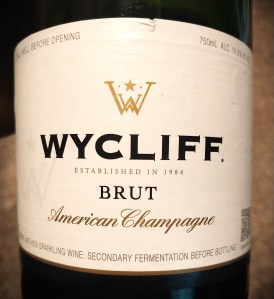
Wycliff Brut American Champagne
- $7.99 at Total Wine & More
- 10.5% ABV
- Charmat Method Sparkling Wine, Secondary Fermentation Before Bottling
- Light-bodied, exuberant perlage
- Wonderful aromas and flavors of apple, citrus, stone fruit, honey
- Balanced, tight acidity keeps it refreshing
- Try it with seafood, spicy foods, and salty snacks
- Perfect for sipping on while watching the Winter Olympics
- If Disney’s Tinkerbell were a wine, this would be it!
Now, for those of you “vino-it-alls”, yes, you are correct, there is no such thing as American Champagne, it is mainly a marketing term. Certain American wineries, though, such as Wycliff, are legally able to use the terms “California Champagne” and/or “American Champagne” due to being grandfathered in to a 2005 trade agreement with the EU.
But since then, American wines have been required to have clearer labelling terms so that consumers aren’t getting duped by American impostors can trust that food products have the authentic origins they claim. 🙂 Burgundy wine can only come from Burgundy, France; Port can only come from Portugal, California sparkling wine can only come from California.
True Champagne is sparkling wine grown and made in Champagne, France. It is also and ONLY made using the traditional method, where a secondary alcoholic fermentation takes place inside each individual bottle, as opposed to a giant tank.
Allow me to illustrate….
Here’s how it works: wine, yeast, and sugar get invited to party in a bottle and get sealed up. The yeast can’t help themselves and go to town gobbling up the sugar and then create more alcohol and carbon dioxide (the bubbles). These wild partygoers are all trapped inside the bottles with nowhere to go. Once the yeast cells have gorged themselves to death, the secondary fermentation is complete. The dead yeast cells settle into a layer of sediment called lees. Rest in peace….
But, wait! Just because they’re dead doesn’t mean their job is finished. The lees break down in a process called autolysis, which imparts those fascinating toasty, almondy, bready flavors that wine people call autolytic character in Champagne or traditional-method sparkling wines. There are a few more steps in the winemaking process, but basically, the spent yeast gets the boot from each bottle via disgorgement. Then the wine is topped off with a little more wine and maybe sugar (called dosage) and then the bottle is sealed with cork and cage. Party’s over, folks (until the cork gets popped).
On the other hand, some sparkling wine, such as Wycliff Brut, is made using the tank method, also known as the Charmat method. It is much quicker to produce and much less labor intensive.
In this method, the original three party guests – wine, yeast, and sugar – are added to a giant tank and then locked inside to party and create another secondary fermentation. Again, those yeast just can’t help themselves and they start their sugar binge, producing alcohol and carbon dioxide. The alcohol and carbon dioxide can’t escape; they are all still trapped together in the tank. This is the point at which the winemaker decides enough is enough, and breaks the dead yeast cells (lees) free from tank prison by filtering them out. Then the remaining dry sparkling wine is bottled under pressure and voila, you’ve got yourself another sparkling wine, just this time without the toasty, bready flavors of autolytic character.
I hope that helped you better understand the difference between traditional and tank production methods. Basically, yeast gets to decompose in bottles (traditional method) but not in tanks (tank/Charmat method).
We should probably also talk about the Asti method in the not-too-distant future. Note to self.
So, there you have it. If I have to grab a sparkling wine that will please me and the vast majority, this is it. It’s also only $8/bottle (as of February 2026), and tastes way above its mere “under $10” price bracket.
Trust me, you can’t go wrong with this wine.
How about you? Have you tried Wycliff Brut? Comment!
 The Rambling Vine