A Rocks District Gem to Rock Your World

Ah, Syrah… one of the world’s great noble varieties. It can sneak across the stage in the background: dark, cloaked, brooding, and mysterious, but it can also slide out onto front and center stage screaming its head off, shredding an electric guitar at a dizzyingly fast pace. And then, everything in between. It can be so many different styles, depending on where it is grown, and how it is vinified.

Que sera sera, or rather, Que Syrah, sera. What Syrah is, it will be.

I need “Que Syrah, sera” on a t-shirt or bumper sticker. 🙂

You think you know Syrah? Think again. Have you ever been fortunate enough to taste a Syrah borne out of the Milton-Freewater Rocks District in Oregon? Well, my friend, let’s chat….

Wines from the Rocks District AVA (American Viticultural Area) have gained acclaim for their distinctly savory and mineral characteristics, which make them taste especially unique.

Let me give you a quick geography lesson….

Take a glance at this map of Washington state wine AVAs and below it the Oregon state wine AVAs:
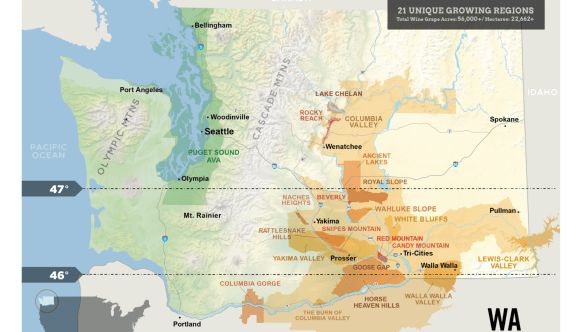
As you can see on the Washington map, the Walla Walla Valley AVA includes land in both Washington and Oregon states. The Rocks District of Milton-Freewater (#22 on the Oregon map) is situated WITHIN the borders of the larger Walla Walla Valley AVA, but is completely on the Oregon side of the Walla Walla Valley AVA.

The only wineries that can put Rocks District AVA on the label have to produce AND bottle their wine in the state of Oregon, which is where the Rocks District AVA is. However, many Washington producers, even though they may source grapes from the very nearby Rocks District, are producing and bottling wine in Washington STATE, so they can only label their wines with the Walla Walla Valley AVA.

So, chances are high I’ve very likely had a Syrah from Walla Walla that contained Rocks District grapes. But with a Washington winery, it wouldn’t necessarily indicate so on the label. On the Washington side, digging deeper is required (sorry for all the rock puns, they’re gonna come flying). 😉

There. Clear as alluvial silt? Hopefully that didn’t hurt your brain too much. If so, take a sip of wine.

So, what makes the Rocks District soil unique? Why all the fuss? In a nutshell, tons of basalt cobbles spewed from a volcanic eruption and deposited by flood waters.

There is literally no topsoil which forces the vines to go DEEP into the earth, to struggle, and this causes the grapes to be lower in number of clusters and smaller in berry size (leading to more powerful, concentrated wine).

These topographical and climatic conditions result in some jaw-droppingly incredible wine, not just with powerful body and tannins, but with aromas and flavors of meat and brine.

Incidentally, if you’d like to read a bit more about minerality in wine from a winemaker (it’s very interesting and not too long), check out winemaker Matt Brain’s  (no, not a typo for Brian – I triple checked) 🙂 article on minerality in wine. Basically, according to Brain,

“… minerality in the soil does not seem to be the major contributor to minerality in the glass. Soils that are thin or deprived of organic matter, however, may contribute to a less fruity and floral grape, allowing mineral characters to be more easily identified.”

Hence why Rocks District wine aromas and flavors come across more pronounced on the mineral spectrum than the fruit/flowers/herbs/spices/etc. spectrums.

This particular Syrah is one I fell in love with at the McMinnville Wine + Food Classic in Oregon. It has rocked me to my molten core every time I’ve tried it and I’ve held on to my one bottle for long enough now. Time to pop the cork and relive the magic!

Rue Cler Rocks District Syrah

Rue Cler Rocks District Syrah

  • $48/bottle
  • 14.4% ABV
  • Sourced from Noble Rock Vineyard in Milton-Freewater, Oregon, Rocks District AVA
  • Winemaker’s notes: “2019 Rocks District Syrah is soft and subtle but lookin’ sharp. Black fruit takes a backseat to savory meats, crushed violets and brine. A charcuterie for the senses! Huckleberries and wet stone give great acid that lingers on the finish. Decant to discover layers of earth and umami in your glass.”
  • Medium ruby color
  • Black plum, soft violet floral component, boysenberry, minerals
  • Very full and soft, not as much punch as I recall it having
  • Aromatic complexity that blew me away initially was not as strong at home
  • Tannins are there but not overpowering
  • Some acidity but very discreet
  • The complex fruit seems to vanish quickly
  • Still, a delicious wine I would buy again

While I was a little surprised this wine didn’t have quite as much acidity as I remember it having when I had it at SIP, it nevertheless delivered much pleasure. Wine is constantly evolving, and it’s highly susceptible to the different environments we drink them in (hello, dinner cooking in the kitchen with poor ventilation) and the various physical states WE consume them in (time of day, hormone levels, and so many other things ALL influence how a wine tastes to us).

This wine is a wonderful introduction to the Rocks District Syrah genre. It is a wine to savor and explore, and I would absolutely buy this wine again.

I hope to unearth some more red wines (especially Syrahs) from The Rocks District of Milton-Freewater. These are something phenomenal and extraordinary. I’m hooked!

Here is a cheat sheet of other wineries using Rocks District fruit if you’d like to go on the hunt for some fine bottles o’ wine: Rocks District Wineries.

Have you ever tried a Rocks District Syrah? Comment!

McMinnville Wine + Food Classic 2023: A Review

On Friday, March 10th, I got up early and hit the road to make the journey down to McMinnville, Oregon, where the 30th Annual McMinnville Wine + Food Classic was taking place. I had not been since 2019, so the absence had definitely compounded my excitement.

This event goes for three days (Friday, Saturday, and Sunday) at the Evergreen Aviation and Space Museum, and is a fundraiser for St. James School in McMinnville, OR. You can purchase tickets for as many days as you like. They even offer shuttle service from downtown McMinnville to the Museum.

McMinnville Wine + Food Classic 2023, Evergreen Aviation and Space Museum. Photo courtesy Eagle Eye Droneography.

McMinnville Wine + Food Classic 2023, Evergreen Aviation and Space Museum. Photo courtesy Eagle Eye Droneography.

There are tons of wineries, but also distilleries, cideries, meaderies, breweries (all the eez). There is obviously food, and a handful of artisans and crafters. You can peruse all of the 2023 participating vendors here.

I tried numerous pours of wine. I would have loved to have tried some other alcoholic products but stuck to my original plan (maybe next year).

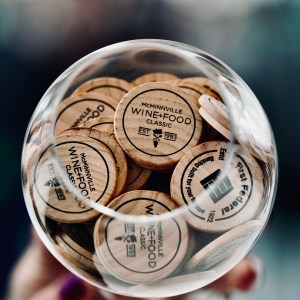
Your ticket purchase includes two tasting tokens. At most places, one token is equal to one pour, but for certain specialty and library wines, two or even three tokens might be required. I wound up purchasing 15 additional tokens, and that was MORE than enough. Having an additional day or two to try more wines would be ideal but I could only attend one day.

Tasting tokens for the McMinnville Wine + Food Classic 2023, Evergreen Aviation and Space Museum. Photo courtesy Eagle Eye Droneography.

Tasting tokens for the McMinnville Wine + Food Classic 2023, Evergreen Aviation and Space Museum. Photo courtesy Eagle Eye Droneography.

I obviously was not able to try every single wine and winery at the festival, but out of the ones I did, here are five wineries and their wines that stood out to me, and that you would not be remiss in checking out. Please note that at some of these vendors I only tried one pour, so this is based on the limited amount I tried that day. I also would have loved to have purchased more bottles but, alas, budgets. 🙂

  1. Denison Cellars 2019 Björnson Vineyard Pinot Noir: This wine really captivated me. Their Pinot was elegant, complex, expressive, beautiful. I sure wish I could have tasted their full line-up but I was trying to spread my tasting tokens out to try more wineries. Time to plan a private tasting at their vineyard in Salem! From the tasting notes: “The resulting wine is deep ruby in color and displays aromas of black cherry, pomegranate, and cranberry. With hints of cola and all-spice, the ripe, velvety tannins provide structure for rich, mouth-filling volume. Flavors of dark red fruit persist into a lingering finish.” $48/bottle. *Of special note for Oregonians: FREE LOCAL DELIVERY for those in Yamhill County, Salem, and Portland with any 3+ bottle purchase. I cannot wait to return and taste more of their wines.
  2. Patton Valley Wines 2018 Lange Vineyard Pinot Noir: Patton Valley has been a brand for over 25 years, but at the moment they are a nomadic winery with no permanent tasting room. I think that’s cool because I’m sure it allows them to save a ton of money and put that towards great winemaking; plus it’s a chance to get creative and have some fun, different tasting options. This was a delicious Pinot Noir I decided to take home as well. $55/bottle. According to the tasting notes, it has a “lush red fruited nose” and a “broad and silky palate.” This is a winery whose offerings you must try if you’re into specific Pinot Noir clones from particular Willamette Valley area vineyards. Visit their website to order wines and to learn where they are pouring.
  3. Domaine de Broglie 2019 Clone 777 Pinot Noir: Established in 2019, Domaine de Broglie is a more recent newcomer to the Dundee Hills AVA. This estate is owned by Francis Ford Coppola and was previously Vista Hills Vineyard. At the 2023 McMinnville Wine Competition, this showstopper wine took home Best of Show, Best Red Wine, and Double Gold! Uh-huh. Here are the tasting notes, you’ll see why: “Aromas of mushrooms, cedar, and forest floor mingle with sweeter aromas of vanilla coffee. A savory, well rounded palate counterpointed with notes of strawberries, red fruit, and salted caramel. An outstanding wine, showcasing the range of expression found in Oregon Pinot Noir.” $62/bottle, 100% Pinot Noir. This wine is music in a glass! This is the indulgence bottle. I did take this beauty home. (I also recall a tried a very enchanting Chardonnay).
  4. Rue Cler 2019 Rocks Syrah: Oh, wow! This is one I will be buying in the future, so intriguing and delicious. $48/bottle, sourced from Noble Rock Vineyard in Milton-Freewater, OR. From the tasting notes: “Black fruit takes a backseat to savory meats, crushed violets and brine…. Huckleberries and wet stone give great acid that lingers on the finish…. Decant to discover layers of earth and umami in your glass.” If you like wines with savory flavors and plenty going on, you’ll love this! Side note: I did not try their Walla Walla Syrah, but one of my tasting companions did and she kept going back for more sips. 🙂
  5. Siltstone 2021 Willamette Valley Pinot Noir: What I especially enjoyed about Siltstone Wines was they make a very good, very drinkable Pinot Noir for $24/bottle. You’re greeted with aromas of cherry, red fruit, and vanilla spice on the nose, and flavors of cherry cola and plum on the palate. The wine is medium-bodied with balanced tannins and a soft smoky finish. As much as I love ultra-fine, premium Pinot Noirs, I just can’t afford them all the time, and I’ll bet you can’t, either. And while $24 for a bottle of wine is a lot for many people (especially right now), when you look at overall pricing for good quality Pinot Noir, you’ll see that it’s very difficult to find GOOD stuff like this in this price range. This is a bargain for lovely Pinot Noir. I also would love to try more of their wines someday.

This event is a great way to get acquainted with a variety of fantastic Willamette Valley wineries all under one roof, and a great excuse to do something fun with your friends.

Have you been to the McMinnville Wine + Food Classic? If so, what did you try and like there? Comment below!

McMinnville Wine + Food Classic 2023, Evergreen Aviation and Space Museum. Photo courtesy Eagle Eye Droneography.

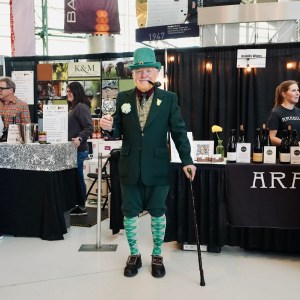
Definitely the best dressed guest! Photo courtesy Eagle Eye Droneography.

Out of the Shadows, Ex Umbris Syrah

Happy St. Patrick’s Day! Here is an Irish blessing for you:

Remember to Forget

Always remember to forget
The things that made you sad.
But never forget to remember
The things that made you glad.

That is something I handle well with wine… I never forget to remember the wines that made me glad. 🙂

While today’s wine is not Irish, it’s made by a gentleman named David O’Reilly at a winery named Owen Roe (I’m guessing there’s some Irish there). 😉

Since it is still Washington Wine Month, it’s only fitting I introduce you to another of my tried-and-true go-to wines (wow, that was a heckuva lotta hyphens): Owen Roe 2020 Ex Umbris Syrah Columbia Valley.

The first time I had Owen Roe wines was at a now defunct wine bar in Fremont. This was among my earlier wine tasting experiences and I just loved every single Owen Roe wine I had, and took home most of them, including the Ex Umbris Syrah. Ex Umbris is Latin for “out of the shadows.”

Here were my tasting notes on the 2010 Ex Umbris:

“Virtually flawless Syrah. Delectable. I want more!”

And, amazingly, I still share those same sentiments in 2023!

According to the winemaker, Ex Umbris was first made in 2002 “… after a wild fire struck the vineyard’s surrounding hillsides. The residual ash and smoke resonated in the Syrah grapes, creating a very memorable wine.” Thus they produce this Syrah every year in keeping with the style of the first vintage. Just to be clear, this does not mean you taste wildfire smoke, not at all.

This is one of my all-time favorite Syrahs, Washington or otherwise. I keep going back to it because it is consistently great and at a very comfortable price for such a high quality wine. Everyone I’ve recommended it to or gifted it to has loved it. And the wine doesn’t lie – winemaker David O’Reilly carefully selects only premium Syrah grapes from top Washington vineyards in Columbia, Yakima, and Walla Walla Valleys for this wine.

Owen Roe Ex Umbris Syrah wine

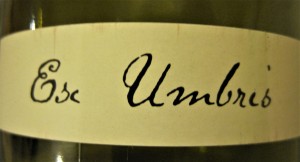
I love the script on the label. Brings back memories of taking calligraphy in middle school.

Here are the details and my impressions of the wine:

  • $17.47/bottle at Total Wine, slightly less at Costco, $21.00 at winery
  • Deep ruby color
  • Full body, 14.1% ABV, mostly dry
  • Aromas/Flavors: Plum, blueberry, raspberry, blackberry, pepper, clay, floral
  • Lush, full fruit flavors, touch of spice, vanilla on the palate
  • Soft yet strong background tannins that offer good support in the wine
  • Good, balanced presence of acidity
  • Long-lasting, gentle finish

In sum, this is a fantastic introductory teaser to the epic level of quality that Washington Syrah can achieve.

I really need to do a road trip and visit their tasting room in Wapato, WA. Not only do they specialize in Washington reds like Syrahs, Cabernet Sauvignon, etc., but also in Oregon reds like Willamette Valley Pinot Noirs. Some of the best of both states, and my top favorite types of wine. But alas, when? Think I’ll go pine away for now….

Anyway, you can purchase Ex Umbris Syrah at Total Wine and certain Costco locations, and obviously through the winery itself. In fact, if you’re a really big fan, you can purchase a case of Ex Umbris directly through the winery and each bottle comes to about $12.42/bottle (before tax, etc.). Unbelievable! (Sadly, this option is sold out at the moment). 😦

So for those of you who prefer red wine to green beer, Guinness, or Bailey’s, raise a glass of Ex Umbris Syrah and proclaim, Sláinte!

Sources
1. Cavoto, Erin, “50 Best Irish Blessings to Read Aloud on St. Patrick’s Day”, The Pioneer Woman, March 1, 2023, accessed March 15, 2023, https://www.thepioneerwoman.com/holidays-celebrations/g35219151/traditional-irish-blessings-prayers/?slide=14

Three Noble Reds, One Outstanding Blend: Skagit Crest Railroad Red

Railroad Red Marries Three Noble Reds Together in One Outstanding Blend

March is Washington Wine Month, a month celebrating the state’s abundant delicious wine and a not so subtle way of trying to get you the consumer to buy more coveted grape juice. 😉

As I sit here reflecting on what I love most about Washington wine, two things come to mind: outstanding quality for the value and uniqueness of place. For Washington Wine Month, although I have plenty of great recommendations to share, I want to introduce you to a unique, truly outstanding Washington wine that encapsulates these values.

Like many people, I enjoy certain value wines at the grocery store (there is a time and a place for everything), but there is not always a distinct sense of place in some of those wines, as many are blended from where ever the winemaker could get decent grapes, and many times they are highly modified and manipulated to cover up poor quality grapes or simply to keep a consistent product.

Every once in a while, it’s good to get up and challenge our palates with something on a different level – to go digging for some true Washington treasure.

Ready for something fun? Here you go!

Skagit Crest Vineyard and Winery is one of my all-time favorite Washington wineries, owned and run by Chuck and Donna Jackson in the Puget Sound AVA. They grow and vint Pinot Noir, Chardonnay, Pinot Blanc, Pinot Gris, Sauvignon Blanc, and a Rosé of Pinot Noir, on their estate in Sedro Woolley, Washington. They also have a tasting room in La Conner, about a half an hour or so away. I have thoroughly enjoyed all of their wines, and I will definitely be posting on more in the future.

They have a red blend consisting of a rather unusual cast of characters that are not typically cast all together: Cabernet Sauvignon, Syrah, and Pinot Noir. These are noble grape varieties, meaning they are among the most popular and widely planted grapes around the world and still largely retain their character even in different growing regions and treatment by winemakers. That’s why a Cabernet Sauvignon from France and a Cabernet Sauvignon from Washington will still both share a lot in common, even though there are various differences in the final product.

If you’re an oenophile (lover of wine) or a Francophile (lover of France) or both (Francoenophile? Ah, how about vin-ophile?), you have probably heard of these famous places. These are three of France’s top winegrowing regions:

  • Bordeaux (famed for blends of Cabernet Sauvignon, Merlot, etc.)
  • Rhone (famed for blends of Syrah, Grenache, Mourvédre, etc.)
  • Burgundy (famed for Pinot Noir and Chardonnay, etc.)

These regions have been growing these particular grapes for centuries, and each region is known for being the absolute best place to grow certain specific varieties. Basically, winemakers from these regions are allowed to make wine only from approved grapes grown in that place and never blend from other regions. French wine laws tend to be very strict in that regard, in order to protect the reputation of their unique wines.

But that’s France, this is America. We go about our winemaking in ways similar and vastly different from France, in part because we are not bound by as many rules and regulations.

Leave it to winemaker Chuck Jackson to shrug at the traditional rulebook on red blends and throw three wonderful reds together in his signature Railroad Red Blend.

I asked Chuck what originally inspired him to create this blend, and this was what he told me:

“In the early planning days of the winery I wanted to offer a Bordeaux blend (likely Cab, Merlot and Cab Franc) and/or a Rhone style blend (likely Syrah, Grenache and Mourvedre) to our eventual line up of wines both of which I really love. After our first harvest from our vineyard it quickly became apparent that was a bit of a pipe dream. Making our own wines and adding Cabernet and Syrah from Eastern Washington was logistically a challenge enough. Adding the other varietals would have meant up to 4 more trips over the hill for grapes and stress our winery for space to make and store the wines for aging. So that dream died.

There was still a desire to have a red blend and I puzzled over just how to do that without stretching us too thin. It finally dawned on me that a potential blend was right in front of us. With three red wines in hand, why not try it. Thus with the 2017 reds we put together our “red blend”, one barrel worth. It was delicious and Railroad Red was born.

The name was Donna’s inspiration given we have a Burlington Northern railroad line running by the west side of our property and vineyard going north to Sumas at the Canadian border. I was subsequently tempted to rename it Trifecta being a blend of Burgundy,  Bordeaux and the Rhone wines. Donna was stuck on Railroad Red so it stands.”

Cabernet Sauvignon and Syrah both require a different growing climate (lots of warmth and sunshine), so the Syrah is sourced from the Yakima Valley AVA (specifically Crawford Vineyard near Prosser) and the Cabernet Sauvignon is sourced from the Horse Heaven Hills AVA (specifically Martinez Vineyard right across the street from the famed Champoux Vineyards). The Pinot Noir is from their own estate grapes (the Puget Sound AVA). Those of you in the know are aware that Pinot Noir is challenging to grow and make into wine (I call it the “picky princess of the grape family”) and the fact that Chuck can create superb Pinot Noir in Western Washington is a testament to his high knowledge and skill.

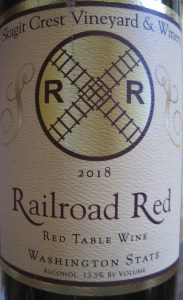
Skagit Crest Vineyard & Winery Railroad Red

Railroad Red: a genius blend of Washington reds.

So let’s take a closer look at the  Skagit Crest Vineyard & Winery 2019 Railroad Red. Three distinctly delicious Washington wines from three different locales, happily carousing in one blend:

  • $30/bottle
  • 13.5% ABV
  • 2019 Blend is 50% Pinot Noir/30% Syrah/20% Cabernet Sauvignon
  • Deep ruby color, full body, dry
  • Well-integrated gripping tannins
  • High, mouth-watering acidity
  • Aromas/flavors: cherry, strawberry, dusty plum, red flower (hibiscus or geranium?), vanilla, touch of chocolate, baking spice, earth (clay or rocks)
  • Finish/length: bright finish, but long, warm, complex, unfolding, lovely

The wine description reads, “Bright berry and cherry aromas with light hints of oak. Cherry and plum on the front to mid-palate. Peppery tones with gravelly earthy flavors in the back palate, lingering bright finish.”

The photo above is of the 2018 label. I love the 2018 blend and also enjoyed the 2019 blend, although they are very different. The 2018 was very round and plush and juicy, but still with that great structure and overall balance I love. That year’s blend consisted of 50% Pinot Noir, 25% Cabernet Sauvignon, and 25% Syrah.

The 2019 blend is wonderful. Because of the high acidity, the 2019 could age a few more years and become really interesting and “gentler” but it’s great to drink now, too. Give your bottle a day or so after opening and that will soften the acid a bit and open up more flavors.

I cannot recommend this blend enough. Make haste and visit their tasting room in La Conner or arrange for a private tasting and tour at their Sedro Woolley Vineyard and Winery (available by appointment only). I’ve done both and suggest you do the same!

Hint hint! April is the month of the Skagit Valley Tulip Festival – so make your plans now to see the gorgeous tulips and sip the gorgeous Skagit Crest wines.

Cheers! 🙂

Skagit Valley Tulip Festival bloom

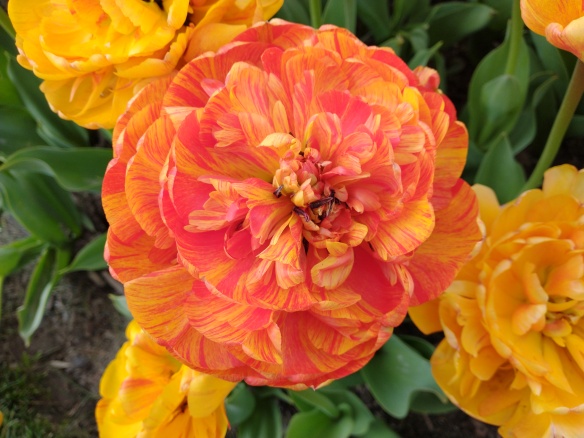
You have to see it to believe it. A bloom I snapped at the Skagit Valley Tulip Festival in 2022.

A special thank you to Chuck and Donna Jackson for answering my questions. 🙂